
 PREVIOUS
A Translational Signal from Marble Burying
Newsletter # 133
Animal models
-
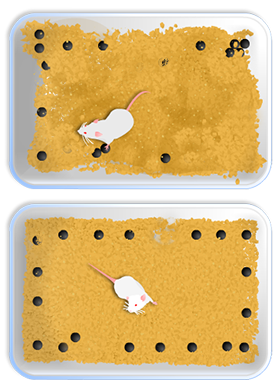
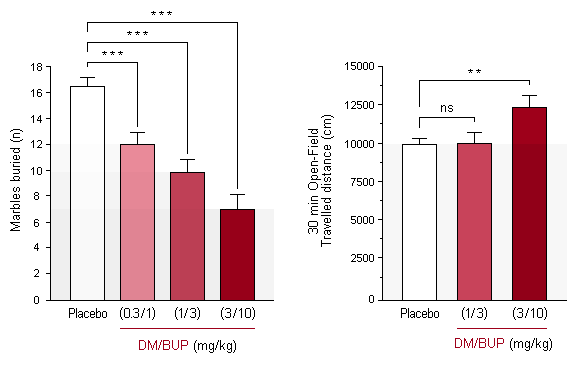
Left panel : The marble burying test measures repetitive, stress-induced behavior in mice exposed to a novel environment and is widely used as a preclinical proxy for compulsive or distress-driven actions. The DM/BUP combination produced a dose-dependent reduction in the number of marbles buried, indicating a selective inhibition of repetitive, stress-driven behavior. Based on a direct weight-for-weight translation from a single Auvelity tablet in a 70 kg human, 1/3 mg/kg was approximated/rounded as reference dose, with 0.3/1 and 3/10 mg/kg corresponding to one-third fraction and three-fold multiple of this reference dose, respectively.
As illustrated by the open-field locomotor data on the right panel, DM/BUP treatment did not reduce travelled distance; thus, the reduction in marble burying was not a result of nonspecific sedation.
1 : https://www.fda.gov/news-events/press-announcements/fda-approves-first-non-antipsychotic-drug-treat-agitation-associated-dementia
Get in touch